

Roughly 74 percent of event attendees say the overall experience shapes how they feel about the host brand or organization, according to research from EventMB (now Skift Meetings). That single figure carries enormous weight for anyone planning a corporate gala, a wedding, or a networking function. It suggests that guests are not passive observers. They arrive with expectations, they form impressions quickly, and they remember how an event made them feel long after the last appetizer disappears.
Yet many planners still approach guest experience as an afterthought, something to address only after the venue, catering, and logistics are locked in. That gap between intention and execution is where most events fall short. Studies in environmental psychology consistently show that physical surroundings shape mood and behavior within seconds of arrival. Branded visual anchors (things guests can see, interact with, and photograph) play a larger role in shaping that first impression than most planners realize. Resources like NYCstep and repeat have documented how intentional backdrop design connects brand identity to attendee behavior in measurable ways, a connection that remains underutilized in mainstream event planning.
Why Guests Disengage Before the Program Even Starts
The challenge is not usually a lack of effort. Planners spend months coordinating speakers, menus, and entertainment. The problem is that guests arrive before any of that begins. They walk into a space, look around, and form a judgment. If the environment feels generic or visually cluttered, or simply like every other event they have attended, disengagement starts early and is difficult to reverse.
Harvard Business School research on service experience found that emotional tone is set within the first few minutes of any service interaction, including events. After that window closes, it takes significantly more effort to shift a guest’s perception. Planners who invest heavily in programming but neglect the arrival experience are, in effect, starting from a deficit.
Social media has amplified this problem. Guests now arrive at events with smartphones in hand and an instinct to document their surroundings. If nothing in the space is worth photographing, many will disengage entirely from the social sharing cycle. For corporate events especially, that missed sharing represents lost organic reach, the kind no advertising budget can fully replace.
How Photo Moments Shift Attendee Behavior
Behavioral research gives us a useful lens here. When people photograph something, they engage with it more deliberately. A Cornell University study found that taking photos of an experience increases enjoyment by drawing attention to details that might otherwise be overlooked. In an event context, this means a well-designed photo area does more than generate shareable content. It slows guests down, encourages interaction, and creates a focal point around which organic conversation clusters.
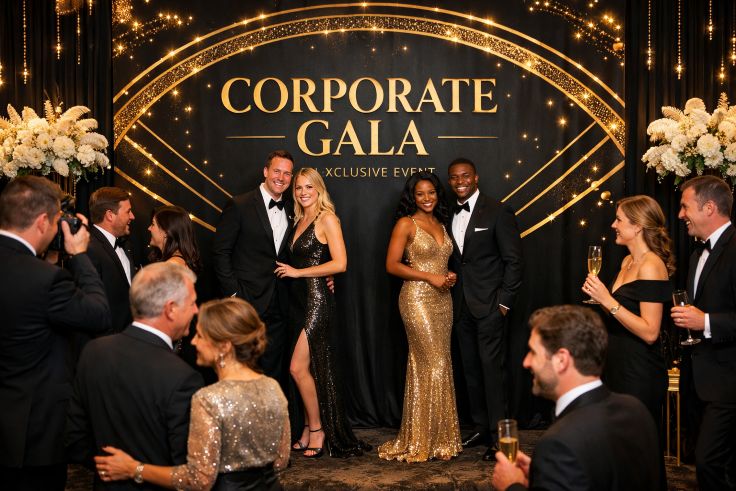
Branded backdrop displays, including step and repeat banners, logo walls, and similar installations, became standard at red carpet events decades ago for practical reasons. Photographers needed a clean visual surface that kept sponsor logos in frame. Over time, event planners noticed something else: guests gravitated to these spaces naturally. They became social hubs. Attendees would queue, chat while waiting, and linger after their photos were taken.
This behavioral pattern is now well-documented in hospitality and event management literature. The Event Leadership Institute notes that designated photo areas consistently rank among the highest-traffic zones at both corporate and social events, regardless of other programming available. The implication is straightforward: guests want a moment that feels staged and memorable, even in informal settings.
Integration Across Event Types
What was once reserved for award shows and product launches has migrated steadily into weddings, conferences, fundraising galas, and professional networking events. The psychology behind this shift is worth understanding.
At weddings, couples increasingly view the photo backdrop as an extension of their visual identity for the day, a deliberate design choice rather than a vendor add-on. At conferences, organizers have found that a well-placed branded display near the entrance or registration area drives social media mentions in the first hour, often before the keynote begins. At galas, the photo wall gives guests a shared ritual that reinforces the event’s prestige and purpose.
According to data from Bizzabo’s annual event trends report, social sharing from events has grown by over 30 percent in the past five years, with photo-based content generating the highest engagement rates across platforms. Planners who treat branded display areas as a functional tool rather than decoration are capturing a disproportionate share of that organic reach.
Networking events present a particularly interesting case. These gatherings are often anxiety-provoking for attendees who do not know many people in the room. A photo installation gives guests something to do, a reason to approach others, and a low-stakes way to initiate conversation. In this context, the backdrop is not just a branding tool. It is a social lubricant.
From Decoration to Strategy
The evolution of branded photo displays reflects a broader shift in how serious planners think about experiential design. A decade ago, the question was whether to include a step and repeat banner. Today the question is where to place it, how to integrate it with the event’s visual identity, and how to encourage guest interaction with it throughout the evening rather than just at arrival.
The Experience Economy, the landmark framework developed by economists B. Joseph Pine II and James H. Gilmore, argued that businesses would increasingly compete on the quality of experiences rather than products or services. Events are perhaps the purest expression of that economy. Every design decision either adds to or subtracts from the experience guests carry home.
Branded display elements, when thoughtfully executed, do several things simultaneously. They reinforce organizational identity, provide a functional photo moment, anchor the room’s visual hierarchy, and give guests a shared touchpoint. As planners focused on creating memorable events on a budget have found, intentionality consistently outperforms spending when it comes to lasting guest impressions.
Planners who understand the psychology behind guest engagement recognize that the physical environment communicates before any speaker takes a stage or any host makes a toast. The guests who walk into a well-designed space feel something different than those who walk into a generic ballroom with a printed sign near the door. That difference is measurable in social sharing rates, post-event surveys, and brand recall studies.
Experiential branding at events is no longer a trend borrowed from advertising agencies. It is a fundamental part of how modern events are designed, measured, and remembered. The planners who grasp this earliest will consistently deliver experiences that guests discuss long after the event ends. That, ultimately, is the only measure that matters.